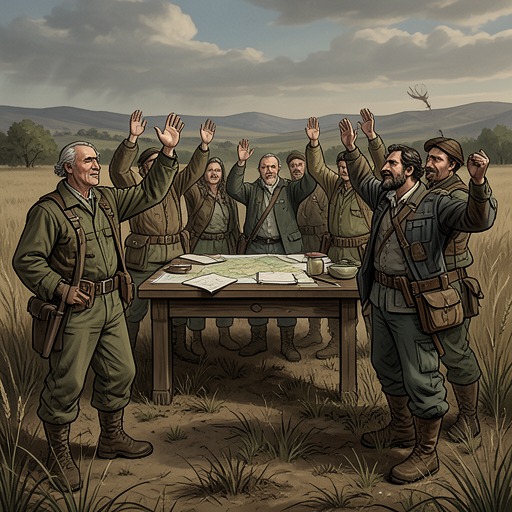
American colonies–Continental Congress relationship
Common SenseThomas Paine presents the relationship between the American colonies and the Continental Congress as a problem of both sovereignty and institutional design: a body first assembled to meet an emergency must become answerable to the people and capable of governing a continent. His argument moves from the inadequacy of distant British rule to a detailed proposal for representation, shared authority, and a Continental Charter, while warning that expedient arrangements cannot safely become permanent without public authorization.
From Wartime Consultation to a Continental Authority
Paine distinguishes the immediate usefulness of the existing Congress from the question of how a continuing continental government should be chosen. When American calamities required consultation, appointing delegates from the several colonial assemblies was the readiest and, at that moment, most proper method; he credits their conduct with preserving the continent from ruin. But necessity does not settle what should follow. Because a Congress is likely to remain necessary, the way its members are selected deserves deliberate reconsideration, especially if the same body can control both representation and election.
The scale of the colonies is central to his case. Paine argues that Britain cannot administer justice across three or four thousand miles when its decision-makers are distant and ignorant of colonial circumstances. A petition can take four or five months to receive an answer, then another five or six months to explain. Such delays make colonial dependence on British authority increasingly impracticable. His alternative is not merely to transfer power to a continental center: it is to build an authority fitted to the colonies’ own distances and interests, with a legitimate connection to the people it governs.
The conflict with Britain has also changed the political purpose of Congress. Before hostilities began on April 19, proposals on both sides still aimed at union with Britain, differing over whether force or friendship could achieve it. Once those approaches failed, Paine treats the old debate as superseded. Continued dependence, he argues, makes the colonies vulnerable to European wars and deprives them of the standing needed to seek mediation or foreign assistance. A declared independence would allow the continent to address other powers in its own right; Congress therefore belongs in an argument about who may speak for the colonies internationally as well as who may govern them at home.
Representation and the Proposed Structure
Paine’s design divides responsibilities between colonial assemblies and a continental Congress. Assemblies would meet annually under a president, provide more equal representation, and attend to domestic business subject to Congress’s authority. The proposal makes the continental body responsible for matters requiring common coordination, rather than treating every colony as a separate political unit or leaving continental concerns to a distant island power.
To make representation workable, each colony would be divided into six, eight, or ten convenient districts, each sending delegates to Congress. Every colony would send at least thirty delegates, giving Congress at least 390 members across the thirteen colonies. The size is meant to prevent a small group from claiming to represent the whole continent and to give the several parts of each colony a route into the common legislature.
Paine also proposes a rotating method for choosing Congress’s president. At each meeting, one colony would be selected by lot from the thirteen; Congress would then elect a president by ballot from that colony’s delegates. At the next Congress, the colony already chosen would be omitted, and the process would continue through the thirteen colonies. The rotation limits the appearance of permanent provincial precedence. For legislation, he proposes that three-fifths of Congress count as a majority, a higher threshold intended to ensure that measures are satisfactorily just rather than passed by a narrow or merely convenient majority.
A Conference, a Charter, and Popular Authority
Because the first step toward a new arrangement should arise neither solely from Congress nor solely from the governed, Paine proposes an intermediate Continental Conference. Its membership would combine experience in public affairs with authorization from the people: twenty-six members of Congress, two from each colony; two members from each assembly or provincial convention; and five popular representatives from each province. Those popular representatives would be chosen by qualified voters gathering in the provincial capital or, where more convenient, in two or three populous places. Paine describes the combination as joining knowledge to power: experienced delegates could advise, while the people’s participation would give the resulting body legal authority.
The Conference’s task would be to frame a Continental Charter, comparable in purpose to Magna Carta. The charter would define the number and selection of members of Congress and the assemblies, specify when they sit, and draw the boundary between their respective jurisdictions. It would secure freedom, property, and, above all, the free exercise of religion according to conscience. Paine insists that continental strength must not erase the rights of separate parts: the proposed bond would oblige the whole to support each colony’s rights, rather than simply enlarge the power of a central institution.
The Conference would dissolve after completing the charter. Legislators and governors chosen under its rules would then take up authority for the time being. This sequence matters: the Conference is not presented as a permanent ruling body, but as a founding instrument whose authority comes from its task and whose work establishes the terms for subsequent institutions. The relationship between Congress and the colonies is thus meant to be constitutional and reciprocal, with Congress operating within a charter formed through a body that joins colonial institutions to popular representation.
Limits, Risks, and the Meaning of Independence
Paine’s case for redesign is reinforced by his criticism of unequal representation within Pennsylvania. When an Associators’ petition came before the assembly, only twenty-eight members were present; eight Bucks County members voted against it. Had seven members from Chester County voted the same way, two counties would have determined the province’s position. For Paine, this example shows how a small and unevenly present assembly can allow a narrow local grouping to speak in the name of an entire colony. The danger is not confined to British rule: colonial institutions also need limits and fair representation if they are to claim authority legitimately.
He further objects that a Pennsylvania assembly had tried to exercise undue authority over the province’s delegates. Instructions put together by a few people, approved by very few outside the assembly, and then passed on behalf of the whole colony show how easily public power can be claimed without broad consent. Paine’s warning that virtue is not hereditary extends the same concern into the future: no constitution should assume that those who inherit or continue political authority will use it well. Election, representation, and accountable jurisdiction therefore cannot be treated as temporary details.
Independence is necessary to this constitutional relationship because, while the colonies call themselves British subjects, other powers cannot readily mediate between them and Britain, and France or Spain have little reason to aid a movement whose stated purpose is to repair the imperial connection. A manifesto explaining the colonies’ grievances, their unsuccessful peaceful efforts, and their willingness to trade peacefully with other courts would do more, Paine argues, than another shipload of petitions to Britain. Under their existing designation, the colonies cannot be received abroad as a people with their own standing. Congress’s continental role consequently belongs to a wider transfer of political authority: the colonies must be able to act together as a community, not remain a subject population seeking redress from the power it resists.
The relationship Paine imagines is neither a loose continuation of emergency committee work nor a new authority free of constraint. Congress must coordinate continental affairs, but its members and powers must be shaped by representative procedures and a charter that protects local rights. The proposed arrangement answers two failures at once: British government is too distant to govern the colonies justly, while small or unequal colonial bodies can misrepresent them. Its constitutional answer is a continental institution made authoritative through participation, defined jurisdiction, and public safeguards.